
Most sports projects fail before execution begins.
The failure usually starts when assumptions become decisions before they have been properly tested.
Sports projects often begin with ambition. A new stadium. A national strategy. A major event. A federation reform. An investor-backed opportunity.
Ambition is not the problem. The problem is premature certainty.
When leaders commit before the decision has been tested, the project carries structural weaknesses from the start. Those weaknesses only become visible once money has been spent and reversing course is hard.
Ambition accelerates.
Momentum builds before scrutiny.
Assumptions harden.
Weak logic becomes commitment.
Exposure compounds.
Execution reveals the weakness.
Execution often exposes weaknesses that already existed.
When sports projects collapse, attention turns to execution.
People blame contractors, timelines, budgets, operators, or political change.
Sometimes those factors matter. But the deeper failure often happened earlier.
The wrong problem was defined. The wrong assumptions were accepted. The wrong governance structure was approved. The wrong sequence was followed.
Execution then exposes the weakness that decision-making created.
A weak decision does not become strong because people work harder.
Sport makes premature commitment easy.
Sport is emotional, public, and highly visible. That is what makes it powerful. It is also what makes weak decisions dangerous.
Sports projects attract excitement quickly. They create headlines. They offer political visibility. They promise community impact. They carry national pride.
Those forces create momentum before the decision has earned it.
Leaders feel pressure to announce, approve, fund, and build before the underlying assumptions have been tested.
AGC exists because high-visibility sports decisions need disciplined scrutiny before commitment.
The recurring patterns AGC looks for.
Sports projects rarely fail for one reason. Failure builds through weak assumptions, poor sequencing, governance gaps, and public pressure.
AGC looks for the patterns that create avoidable exposure.
The Optimism Trap
Optimism is common in sport. It helps leaders build support and create momentum. But optimism becomes dangerous when it replaces evidence.
Revenue projections become aspirational. Utilisation assumptions go untested. Sponsorship expectations inflate. Operating costs are underweighted.
The project starts to look viable because the presentation is persuasive.
Not because the assumptions have survived scrutiny.
AGC separates ambition from evidence.
Governance Exposure
Sports projects fail when authority is unclear. A project may have support but no clear owner. It may have committees but no decision control. It may have public backing but weak accountability.
When pressure increases, weak governance becomes visible. Decisions slow. Conflicts emerge. Responsibilities blur. Funding confidence weakens.
AGC tests whether the governance can survive the decision it is being asked to support.
Operational Unsurvivability
A project can succeed at launch and fail in operation. Opening day is not the test. Year three is the test.
Who operates the facility? Who maintains it? Who pays for lifecycle costs? What utilisation is realistic? How does the asset generate repeat revenue?
If those questions are not answered early, the project becomes operationally fragile after the public celebration ends.
AGC examines whether the decision can survive beyond launch.
Stakeholder Misalignment
Sports projects involve governments, federations, investors, communities, operators, and sponsors.
Support is not the same as alignment. Stakeholders may agree publicly while expecting different outcomes privately. They may support the idea but disagree on funding, control, rights, or risk allocation.
Misalignment becomes expensive when it appears after commitment.
AGC identifies where stakeholder expectations must be clarified before commitment.
The Sequencing Collapse
The order of decisions matters. Projects move to design before governance is clear. Announcements happen before funding is secured.
Procurement begins before scope is stable.
The project looks like it is progressing. But the sequence is creating risk.
Bad sequencing turns uncertainty into exposure.
AGC defines what must be decided first, what must wait, and what evidence is required.
Commercial Overconfidence
Many sports projects underestimate the difference between attention and revenue.
A sport may have global popularity. That does not create local ticket sales, sponsorship value, or year-round venue utilisation.
A facility may look attractive. Without a credible use strategy it becomes an expensive asset with limited recurring revenue.
A tournament may create excitement. Excitement alone does not pay for operations, talent, venues, and governance.
AGC tests whether the commercial model can survive real market behaviour.
The Feasibility Illusion
A feasibility study can be valuable. It can also create false confidence if it is commissioned too late or built on assumptions that were never challenged.
If the brief assumes the answer, the study simply organises the assumption. That is not decision protection.
Before feasibility becomes useful, the decision must be diagnosed. The problem must be defined. The exposure must be understood.
AGC works before feasibility becomes a box-ticking exercise.
Public Commitment Before Private Clarity
One of the most dangerous moments in a sports project is the public announcement.
Once a project is publicly announced, the pressure changes. The decision becomes political. Expectations rise. Reversal becomes harder. Rational pause looks like failure.
That is why clarity must come before commitment.
AGC pressure-tests the decision before it becomes public exposure.
Public momentum makes weak decisions harder to reverse.
The earlier a weak decision is identified, the easier it is to correct.
Before announcement, a project can be questioned. Before procurement, scope can change. Before capital commitment, a model can be restructured. Before construction, sequencing can be corrected.
Once a decision becomes public, the cost of correction increases. Leaders feel pressure to continue because stopping looks uncomfortable. Investors lose confidence. Political capital may already be committed.
Execution cannot compensate for a decision that was flawed at commitment. If the commercial model is weak, delivery discipline will not create demand. If governance is unclear, activity will not create authority. If the decision cannot survive scrutiny, execution makes the failure more expensive.
This is why AGC works before exposure compounds.
"Before this gets harder to reverse, we should probably speak to AGC."
AGC changes the sequence.
Most weak projects follow the wrong sequence. They move from ambition to announcement, then to delivery, and only later discover the hidden risk. AGC reverses that pattern.
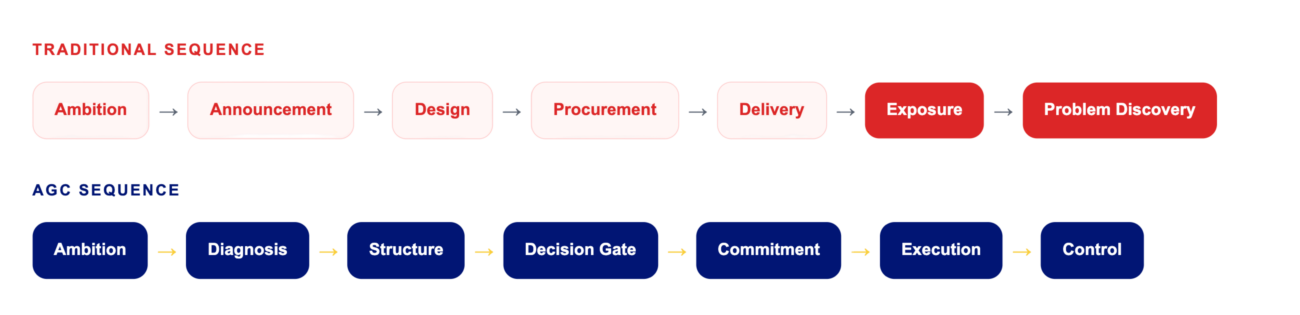
AGC helps leaders create clarity before commitment by diagnosing the decision, structuring the pathway, and identifying whether the responsible outcome is Proceed, Pause, or Stop.
This does not slow good projects down. It protects them from avoidable failure.
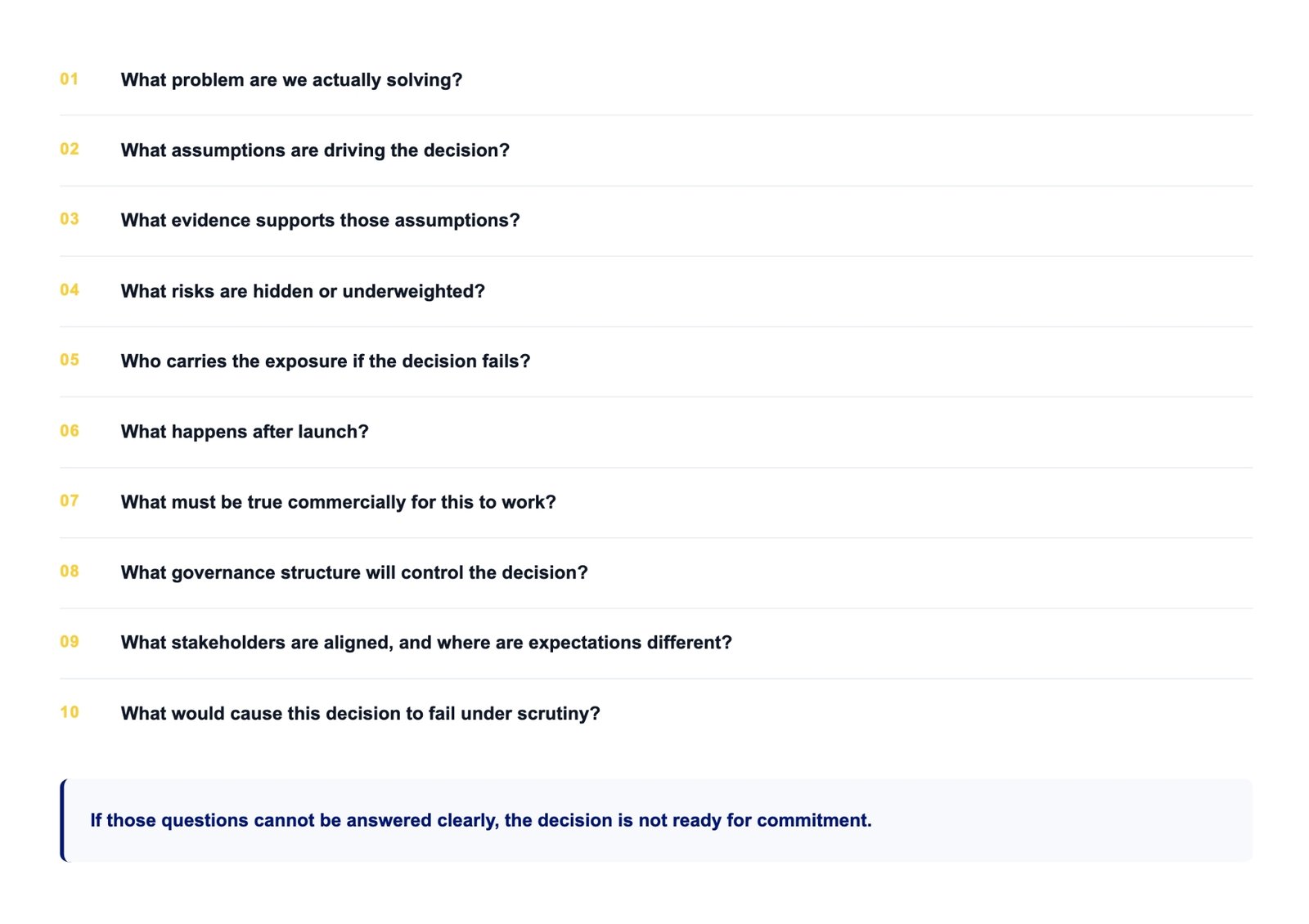
Before commitment, the decision should answer hard questions.
A high-stakes sports decision should not proceed until leaders can answer:
Do not wait for execution to reveal a decision problem.
If your organisation is considering a major sports decision, AGC can help pressure-test the assumptions, risks, governance, commercial logic, stakeholder alignment, and exposure before commitment.
The goal is not to slow ambition. The goal is to protect it.