
Pressure-test the decision before commitment.
AGC diagnostics reduce decision risk before capital, credibility, political exposure, or public trust are put at stake.
A diagnostic is not a report for the sake of a report. It is a decision tool.
AGC diagnostics identify what is known, what is assumed, what is exposed, and what is missing. They decide whether the responsible next step is to Proceed, Pause, or Stop.
Before AGC scopes execution or recommends partners, we first diagnose the decision.
Input
Ambition. Pressure. Opportunity. Uncertainty.
Diagnostic
Scrutiny. Evidence. Risk. Structure.
Output
Proceed. Pause. Stop.
Most organisations diagnose operational problems too late.
By the time delivery problems appear publicly, the underlying decision has already become expensive, visible, and hard to reverse.
The budget is committed. The announcement has been made. The investors are watching. The public expectation exists.
At that point, leaders are no longer solving the original decision problem. They are managing the consequences of an untested commitment.
AGC diagnostics intervene earlier, while the decision can still be improved, paused, or stopped.
The cost of a weak decision compounds after commitment.
Without proper diagnostic scrutiny, sports decisions can move forward with weaknesses that remain hidden until the cost of correction increases.
INVESTOR CONFIDENCE WEAKENS
Projects not ready for diligence often lose credibility before capital conversations have properly begun.
GOVERNANCE BECOMES REACTIVE
When authority, accountability, and decision rights are unclear, pressure exposes the weakness.
SEQUENCING COLLAPSES
Design, procurement, funding, and delivery occur in the wrong order, creating avoidable risk.
COMMERCIAL LOGIC BREAKS
Revenue assumptions, utilisation forecasts, and operating models fail under real market conditions.
PUBLIC EXPOSURE INCREASES
Once a decision becomes public, rational pause looks like failure. Weak decisions become harder to reverse.
EXECUTION BECOMES EXPENSIVE
Delivery activity can magnify a flawed decision rather than correct it.
The objective is not activity. The objective is clarity.
"Before this gets harder to reverse, we should probably speak to AGC."
No diagnosis, no scope.
AGC does not define major execution work before understanding the decision risk. That is not a sales tactic. It is a discipline.
A project may appear to need a stadium strategy. The real issue may be commercial viability. A federation may ask for a growth plan. The real risk may be governance. A government may request a sports tourism strategy. The missing foundation may be facility readiness. An investor-facing project may appear ready for capital. The structure may not survive diligence.
Without diagnosis, scope becomes guesswork. AGC starts with the decision, because the decision determines the pathway.
Every AGC diagnostic leads to a decision.
The purpose of diagnosis is not to create more activity. It is to create decision clarity.
Proceed.
The decision is strong enough to move forward with the right governance, sequencing, and controls.
Pause.
The decision may be viable. But unresolved risks, missing evidence, or governance gaps must be addressed before commitment. Pause is also where weak decisions are restructured.
Stop.
The decision does not currently survive scrutiny. It should not proceed in its present form. Avoiding the wrong execution is value, not failure.
AGC diagnostic pathways.
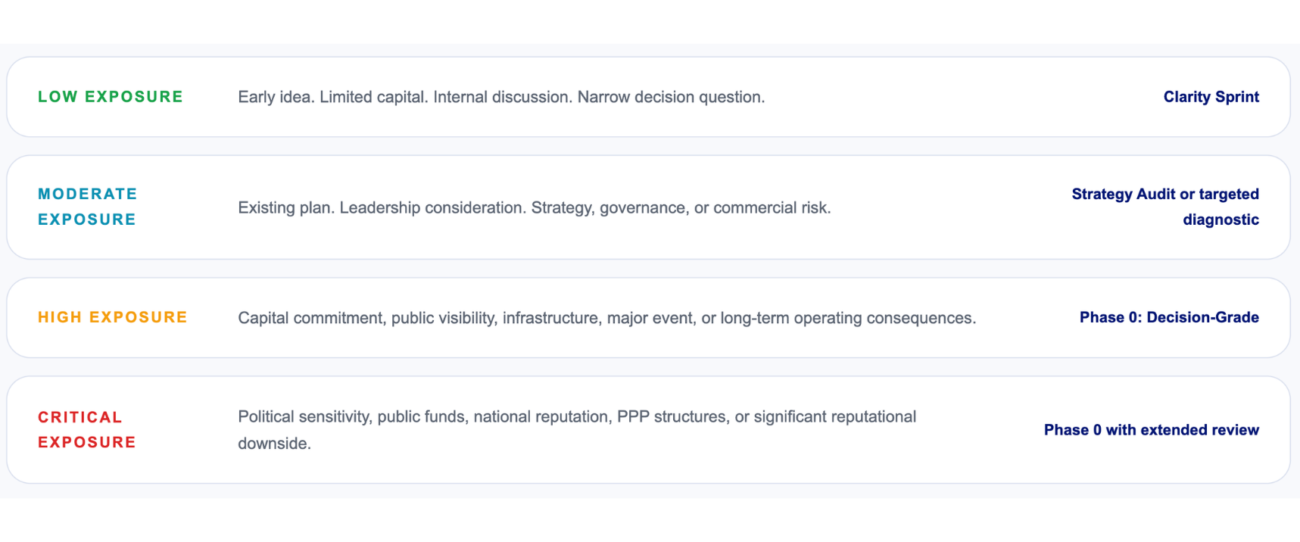
The right diagnostic depends on the level of exposure attached to the decision.
Low-exposure questions may need a short diagnostic. High-stakes decisions involving capital, public visibility, governance complexity, or political sensitivity need deeper scrutiny.
AGC recommends the pathway based on the decision, not on a pre-set sales menu.
EARLY CLARITY & STRATEGIC DIRECTION
Clarity Sprint
Best for: Early-stage uncertainty, idea validation, or initial decision framing. When a decision needs rapid clarification before further time, credibility, or resources are committed.
WHAT IT TESTS
The real decision being made. Whether the problem is properly defined. The assumptions behind the idea. The immediate risks and options. Whether a deeper diagnostic is required.
TYPICAL OUTPUT
A concise decision brief identifying the core issue, immediate risks, key assumptions, and recommended next step.
BEST OUTCOME
Clarity on whether to Proceed, Pause, Stop, or escalate into a deeper diagnostic.
Strategy Audit
Best for: Sports organisations, federations, or leadership teams with an existing strategy or plan that needs to be tested for coherence, realism, and defensibility.
WHAT IT TESTS
Strategic logic. Alignment between ambition, resources, and capability. Governance and delivery readiness. Commercial assumptions. Implementation risk.
TYPICAL OUTPUT
A structured strategy audit highlighting strengths, weaknesses, decision risks, and recommended adjustments.
BEST OUTCOME
A stronger, clearer, more defensible strategy before wider commitment.
Fractional CXO Diagnostic
Best for: Organisations where leadership bandwidth or executive capacity may be the real constraint behind underperformance, and where senior advisory support is being considered.
WHAT IT TESTS
Leadership capacity and gaps. Role clarity. Decision flow. Whether executive support is genuinely required, and at what level.
TYPICAL OUTPUT
A leadership and operating diagnostic identifying the executive capability required and how fractional leadership should be structured.
BEST OUTCOME
Clarity on whether fractional executive support is required, what role is needed, and how it should be governed.
INFRASTRUCTURE, CAPITAL & FEASIBILITY EXPOSURE
Rapid Feasibility
Best for: Early-stage facility, infrastructure, event, or investment concepts that need fast feasibility screening before capital or contracts are committed.
WHAT IT TESTS
Concept viability. Market and utilisation logic. Initial cost and revenue assumptions. Delivery realism. The major red flags.
TYPICAL OUTPUT
A rapid feasibility assessment identifying whether the concept is viable, exposed, underdeveloped, or unsuitable. Includes defined assumptions and sensitivities.
BEST OUTCOME
A fast, defensible go / no-go / modify position before sunk costs accumulate.
Investor Readiness Diagnostic
Best for: Project owners, developers, federations, and governments preparing to approach investors, lenders, family offices, or strategic partners.
WHAT IT TESTS
Investment narrative. Revenue and cost assumptions. Governance and risk allocation. Capital structure. Operating model. Documentation readiness. Likely investor objections.
TYPICAL OUTPUT
An investor readiness report identifying what will survive diligence, what will be challenged, and what must be strengthened before investor engagement.
BEST OUTCOME
A project that is more credible, more defensible, and better prepared for capital conversations.
Facility Profitability Reset
Best for: Venue owners, operators, federations, clubs, and academies with underperforming facilities, weak utilisation, or increasing operating pressure.
WHAT IT TESTS
Revenue streams and utilisation. Operating costs and maintenance burden. Pricing and programming. Sponsorship and event opportunities. Long-term asset performance.
TYPICAL OUTPUT
A facility performance report with risks, missed revenue opportunities, operational weaknesses, and a reset pathway.
BEST OUTCOME
A clearer plan to improve utilisation, revenue, and long-term viability.
COMMERCIAL, SPONSORSHIP & REVENUE EXPOSURE
Sponsor Sprint
Best for: Organisations testing sponsorship readiness, commercial positioning, and revenue potential. Before going to market, or after sponsorship interest is failing to convert.
WHAT IT TESTS
The sponsorship proposition. Partner categories and inventory. Audience value and pricing. Activation credibility. Sales process discipline. Decision ownership.
TYPICAL OUTPUT
A sponsor readiness brief identifying what can credibly go to market, what must be strengthened, and where commercial ambition must be repositioned.
BEST OUTCOME
A more credible and commercially defensible sponsorship proposition.
GOVERNANCE, EVENT & INSTITUTIONAL EXPOSURE
Governance & Compliance Diagnostic
Best for: Federations, governing bodies, boards, organising committees, and institutions facing governance pressure, stakeholder fragmentation, compliance issues, or accountability risk.
WHAT IT TESTS
Decision authority. Board and management structure. Accountability mechanisms. Operational governance and risk controls. Compliance exposure. Stakeholder confidence.
TYPICAL OUTPUT
A governance diagnostic identifying weaknesses, exposure points, structural gaps, and recommended reforms.
BEST OUTCOME
Stronger decision-making, reduced institutional exposure, and improved stakeholder confidence.
Event Readiness Diagnostic
Best for: Organisations preparing to host, bid for, or deliver tournaments, multi-sport events, international competitions, or other commercially significant sports events.
WHAT IT TESTS
Operational and venue readiness. Stakeholder responsibilities. Budget logic and delivery timelines. Broadcast, security, and medical planning. Commercial readiness. Legacy planning. Risk exposure.
TYPICAL OUTPUT
An event readiness assessment showing whether the event is ready, where risk sits, and what must be addressed before delivery or public commitment.
BEST OUTCOME
A realistic view of event readiness before commitments become public, contractual, or irreversible.
HIGH-STAKES INTEGRATED EXPOSURE
Phase 0: Decision-Grade Diagnostic
Best for: High-stakes decisions involving major capital expenditure, public-sector exposure, infrastructure development, major events, national programmes, or politically visible commitments.
WHAT IT TESTS
Strategic rationale. Commercial survivability and capital realism. Governance structure and stakeholder alignment. Delivery pathway and operational readiness. Political and reputational exposure. Evidence gaps and decision options.
TYPICAL OUTPUT
A decision-grade diagnostic report with findings, risks, assumptions, options, recommendations, and roadmap. Designed to withstand board scrutiny, investor diligence, and public accountability.
BEST OUTCOME
A defensible decision on whether to Proceed, Pause, or Stop before major commitment.
Diagnostic engagements are scoped to decision complexity, exposure, and urgency. Entry-level diagnostics may begin with a Clarity Sprint. High-stakes decisions are scoped to match the exposure.
The greater the exposure, the stronger the diagnostic requirement.
Not every decision requires the same level of diagnostic depth.
When the decision involves capital, political visibility, public trust, or long-term operating obligations, the cost of being wrong increases.
AGC uses exposure to determine diagnostic depth.
How to start a diagnostic.
Submit The Decision
Tell AGC what decision you are considering, where it sits, who is involved, and what is at stake.
AGC Reviews Exposure
AGC reviews the strategic, commercial, governance, and political exposure attached to the decision.
Diagnostic Pathway Recommended
AGC recommends the appropriate diagnostic pathway based on risk, urgency, and decision stage.
Diagnostic Begins
Once scope, timing, and engagement terms are agreed, AGC begins the diagnostic process.
Decision Output Delivered
The diagnostic produces a clear decision pathway: Proceed, Pause, or Stop.
Before you commit, pressure-test the decision.
If your organisation is about to commit capital, credibility, or public trust to a sports decision, AGC can help determine whether it is ready to proceed.
Do not let momentum replace scrutiny.