
Diagnosis. Structure. Execute.
A disciplined sequence for reducing decision risk before and during high-stakes sports commitments.
AGC does not begin with execution. We begin with the decision.
Before a project is scoped, funded, announced, or delivered, AGC pressure-tests whether the decision is ready to move forward.
Diagnosis creates clarity. Structure creates defensibility. Execution creates controlled delivery, but only after the decision has earned the right to proceed.
1. Diagnose
Pressure-test the decision.
2. Structure
Build a defensible pathway.
3. Execute
Deliver with control.
4. Gate Outcomes
Proceed. Pause. Stop.
The order of decisions determines the quality of execution.
In sport, many projects move too quickly into action.
A concept becomes an announcement. A preferred solution becomes a scope. A design becomes a commitment. A delivery timeline becomes a political promise.
When action comes before clarity, execution does not reduce risk. It magnifies it.
AGC exists to change that sequence. We help leaders test the decision before the organisation commits more capital, credibility, or public trust.
AGC reverses the sequence.
By diagnosing the decision first, AGC helps leaders see whether the opportunity is ready to move forward, needs more evidence, or should stop before exposure increases.
The result is not more complexity. The result is better decision discipline.
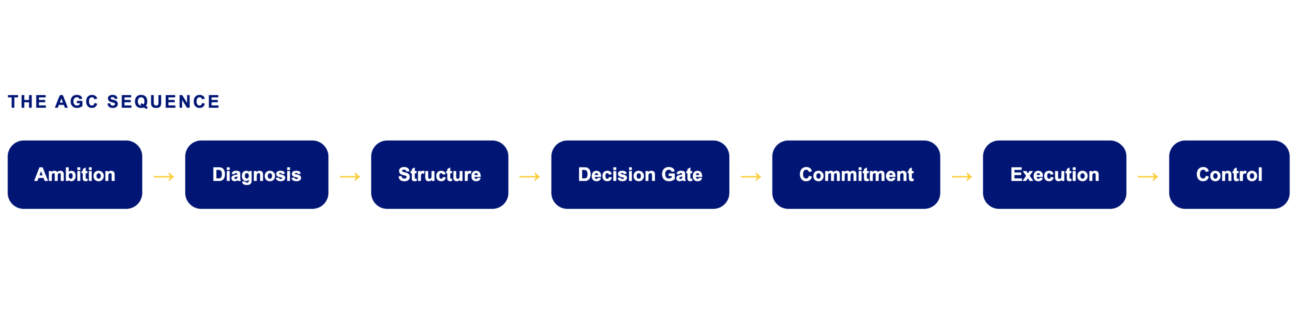
For context on the sequence most weak projects follow, and why it creates avoidable exposure, see Why Projects Fail.
Diagnosis.
Pressure-test the decision before defining the solution.
Diagnosis identifies the real issue beneath the stated request.
A client may ask for a stadium strategy. The real problem may be commercial viability. A federation may ask for a growth plan. The real risk may be governance. A government may request a sports tourism strategy. The missing foundation may be facility readiness.
An investor-facing project may appear ready for capital. The structure may not survive diligence.
AGC diagnoses the decision before defining the scope.
DIAGNOSTIC QUESTIONS
- What decision is actually being made?
- What problem is the organisation trying to solve?
- What assumptions are driving the decision?
- What evidence supports those assumptions?
- What risks are hidden or underweighted?
- Who carries the exposure if the decision fails?
- What would cause the decision to fail under scrutiny?
- What must be true for the decision to succeed?
Structure.
Build a pathway that can be defended before it is delivered.
Once the decision has been diagnosed, AGC helps structure the pathway forward.
Structure is where ambition becomes disciplined. It defines what must happen, in what order, under what governance, and under what risk controls.
Without structure, a project may move quickly but remain fragile.
Structure turns ambition into a decision pathway that can survive scrutiny.
Governance
Who has authority, who carries responsibility, and how decisions will be controlled.
Commercial Logic
How the opportunity creates value, generates revenue, manages cost, and survives real market conditions.
Stakeholder Alignment
Who must support the decision, what they expect, and where misalignment could create risk.
Capital Pathway
What funding logic is realistic, what investors will scrutinise, and what assumptions must be strengthened.
Sequencing
What must happen first, what must wait, and what decision gates must be passed before further commitment.
Operational Readiness
How the project survives beyond announcement, opening day, or initial visibility.
Execute.
Execution follows clarity.
AGC supports execution only after the decision has been properly diagnosed and structured.
Execution may include strategic oversight, owner's representation, PMO support, operational readiness, and decision control.
But execution is not the starting point. Execution is the result of a decision that has been tested, structured, and approved to move forward.
That is how AGC protects clients from activity that looks like progress but increases exposure.
Execution matters. But execution must serve a decision worth executing.
Strategic Oversight
Maintaining alignment between the original decision, the approved structure, and the delivery pathway.
PMO and Decision Control
Creating reporting discipline, risk visibility, accountability, and escalation pathways.
Operational Readiness
Preparing the project, facility, event, or organisation to function after launch.
Stakeholder Coordination
Keeping decision-makers, partners, funders, and operators aligned.
Handover and Continuity
Ensuring execution does not end with delivery but supports long-term survivability.
Every stage must pass a decision gate.
AGC does not treat progress as automatic. Each stage must justify the next level of commitment.
A decision should not move forward simply because time has passed, money has been spent, or momentum exists. It should move forward because the evidence supports it.
Proceed.
The decision is strong enough to move forward with the right structure, governance, controls, and sequencing.
Pause.
The decision may be viable. But unresolved risks or missing evidence must be addressed before further commitment. Pause is also where weak decisions are restructured.
Stop.
The decision does not currently survive scrutiny and should not proceed in its present form.
"This is the kind of decision we should probably bring to AGC."
The principles behind the AGC model.
These are not slogans. They are the conditions under which AGC works.
01
No diagnosis, no scope.
AGC does not define major execution work before understanding the decision risk.
02
No evidence, no claim.
Recommendations must be grounded in evidence, validated assumptions, or clearly stated areas requiring further validation.
03
No gate passed, no next phase.
High-stakes decisions should move through clear decision gates before additional commitment.
04
Stop is a legitimate answer.
A decision that should not proceed must be identified before it becomes harder, more expensive, and more politically difficult to reverse.
05
Execution must serve the decision.
Delivery activity is only valuable when the decision behind it is sound.
06
Clarity is the product.
The purpose of AGC's work is not activity. It is decision clarity under scrutiny.
Start with the decision.
Before you commission another plan, announce another project, approach another investor, or commit more capital, pressure-test the decision.
AGC helps leaders diagnose risk, structure defensible pathways, and execute only after the decision has earned the right to proceed.